Goethe Accelerator Physics (GAP)
Working Group at the Institute for Applied Physics (IAP)
Led by Prof. Dr. Giuliano Franchetti, our group investigates advanced accelerator physics. We specialize in single-particle nonlinear dynamics, space-charge-driven collective phenomena, and long-term beam stability criteria for present and the next generation of high-intensity storage rings.
Group Activity Summary
The Goethe Accelerator Physics (GAP) group works at the intersection of high-energy physics, nonlinear mathematics, and high-performance computing. Over the past two decades, our research has focused on characterizing the complex stability boundaries governing high-intensity particle beams as they circulate through circular accelerators over millions of revolutions. Our research activities are organized into three core operational workflows:
Theoretical Modeling
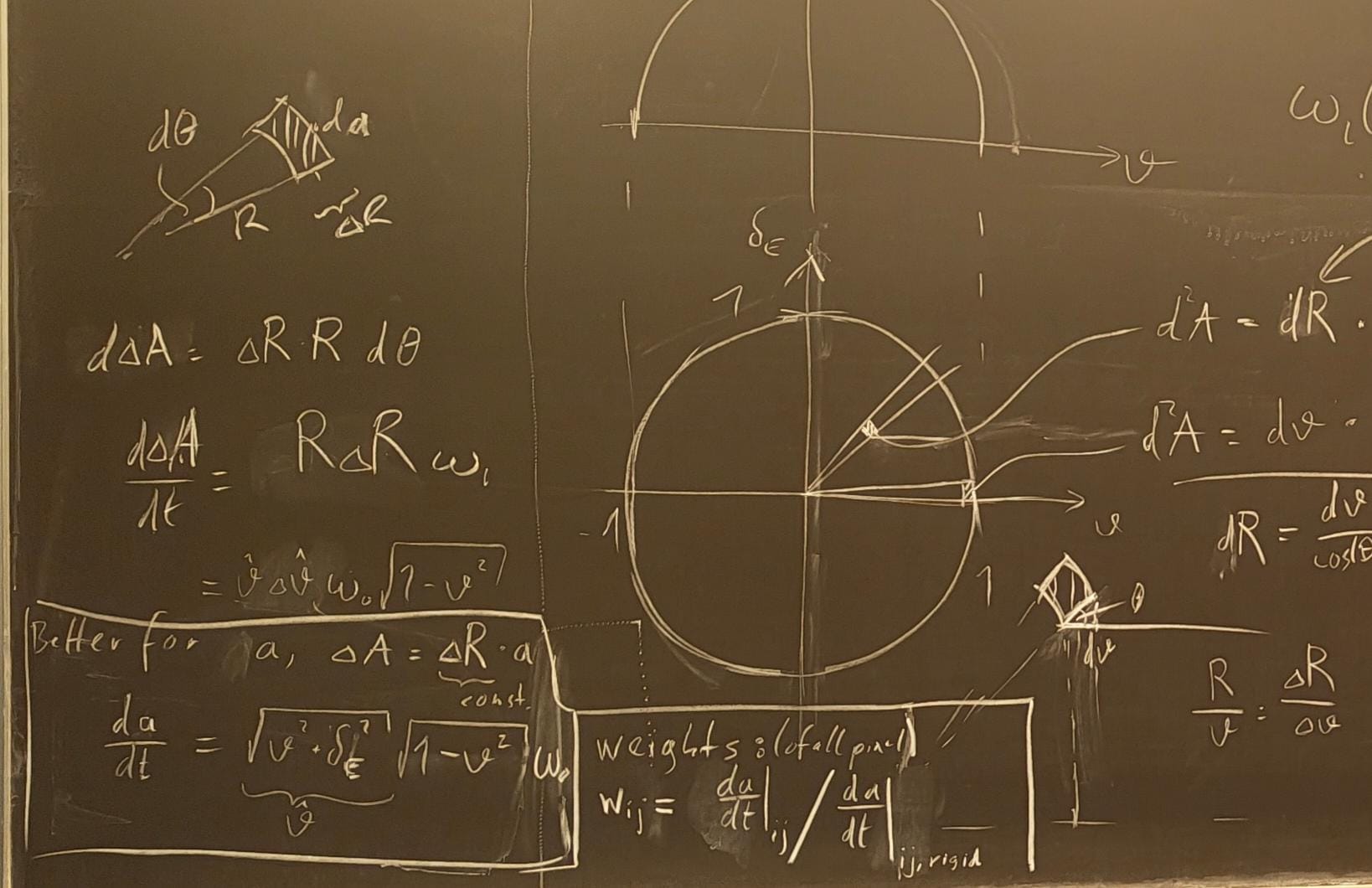
Our research aims to understand the fundamental mechanisms governing high-intensity beams in circular accelerators, with a particular focus on beam stability, single-particle chaos, resonance island trapping, nonlinear fixed lines, and collective effects. By developing rigorous mathematical frameworks, we seek to describe and predict complex nonlinear beam dynamics, identify stability limits, and understand the mechanisms leading to beam degradation and losses.
High-Performance Simulations
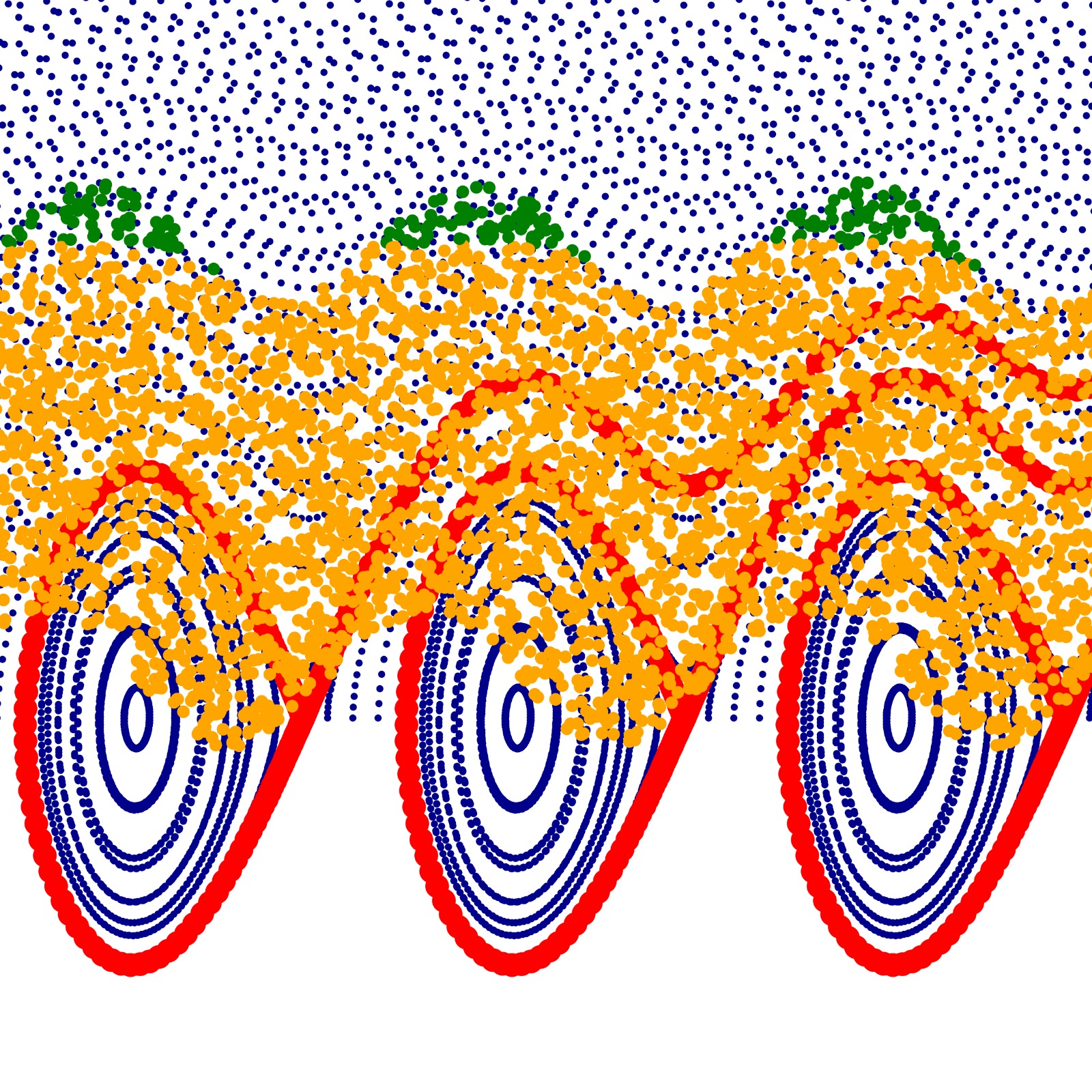
Developing, optimizing, and benchmarking large-scale Particle-in-Cell (PIC) simulation and tracking frameworks for high-intensity beams in circular accelerators. These models enable self-consistent simulations of space-charge forces and collective beam dynamics, leveraging high-performance computing architectures to study dense particle distributions and their impact on beam stability and evolution.
Experimental Verifications
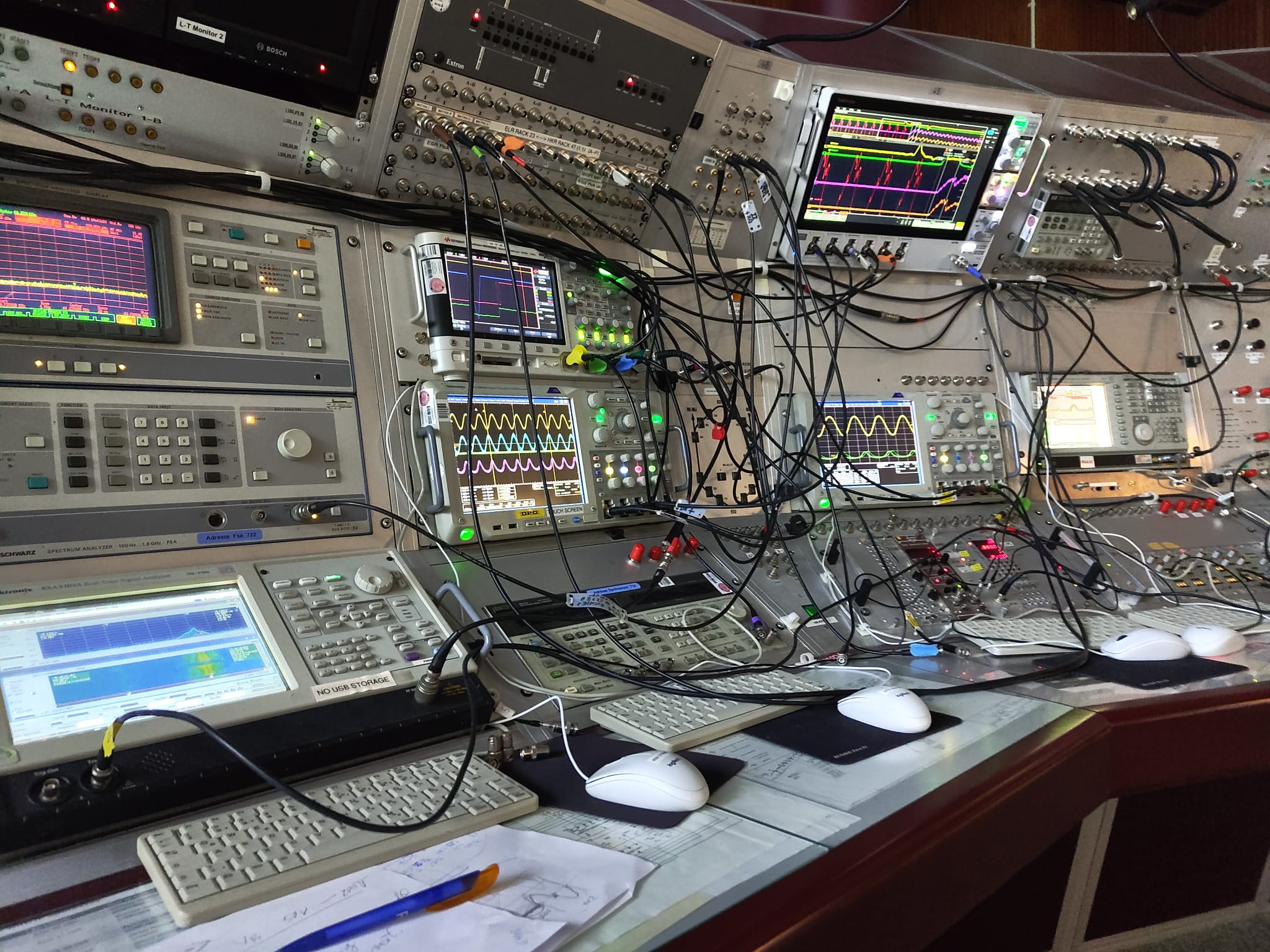
Validating theoretical predictions and numerical simulations through dedicated experiments at operational synchrotrons. Through collaborative research campaigns at leading international accelerator facilities, we investigate beam dynamics and stability under realistic operating conditions, bridging theoretical developments, computational models, and experimental observations.
Institutional Network & Partners
GSI Helmholtzzentrum
Through close collaboration and joint appointments with GSI Helmholtzzentrum für Schwerionenforschung in Darmstadt, GAP connects fundamental research in beam physics with experimental investigations at operating accelerator facilities. This partnership provides direct access to the ESR storage ring and the emerging FAIR complex, enabling theoretical predictions and numerical models to be tested and validated under realistic accelerator conditions.
HFHF Academy
Our group is a member of Helmholtz Research Academy Hesse for FAIR (HFHF), which promotes cross-institutional collaboration to address key challenges in beam physics, including intensity limitations, beam stability, and advanced beam dynamics. The Academy targets challenges faced by high-intensity facilities such as FAIR, combining developments for the GSI ion linacs with cross-disciplinary technologies, including advanced detectors and machine learning, to improve accelerator performance.
HGS-HIRE
Our doctoral candidates are deeply embedded within the Helmholtz Graduate School for Hadron and Ion Research (HGS-HIRE), benefiting from structured interdisciplinary training pipelines and direct integration into the international heavy-ion community.
Group Highlights & News
Fixed Lines Observed at CERN SPS
In a historic collaborative breakthrough published in Nature Physics, GAP alongside CERN scientists experimentally verified the existence of "fixed lines" driven by nonlinear resonances. This expands our understanding of phase-space dynamics and long-term beam degradation limits.
The FAIR Optimization Pipeline
Our ongoing theoretical research, numerical modeling, and high-performance computing developments directly support the advanced modeling and optimization of the GSI accelerator complex. This includes accelerator optics optimization and the development of strategies to understand and mitigate collective effects, ensuring the stability and performance of high-intensity heavy-ion beams required across the different phases of the FAIR project.
Core Research Framework
Nonlinear Single-Particle Dynamics
Mapping out chaotic tracking regimes, resonance island structures, and adiabatic particle trapping. We focus on the fundamental mathematics governing particle behaviors in complex electromagnetic lattices over millions of turns.
High-Intensity Space Charge Effects
Simulating the self-consistent Coulomb forces within intense beam bunches. Our research models how these forces coupling with external non-linearities trigger structural beam instabilities, emittance growth, and severe halo formation.
Innovative Trapping Architectures
Exploring novel concepts in beam physics, including the trapping of neutral molecules directly via the intense beam electromagnetic fields, opening up fresh avenues for cross-disciplinary particle interactions. We engage in studies of complex beam physics as the beam dynamics during deceleration, the modeling IntraBeam Scattering ot the Shottky disgnostics for intense bunched beams.